Locks and canal cruising: how it works
Doubled lines, boathook, turbulence, air draft and waterway licences: everything you need to pass your first lock and cruise the canals with confidence.
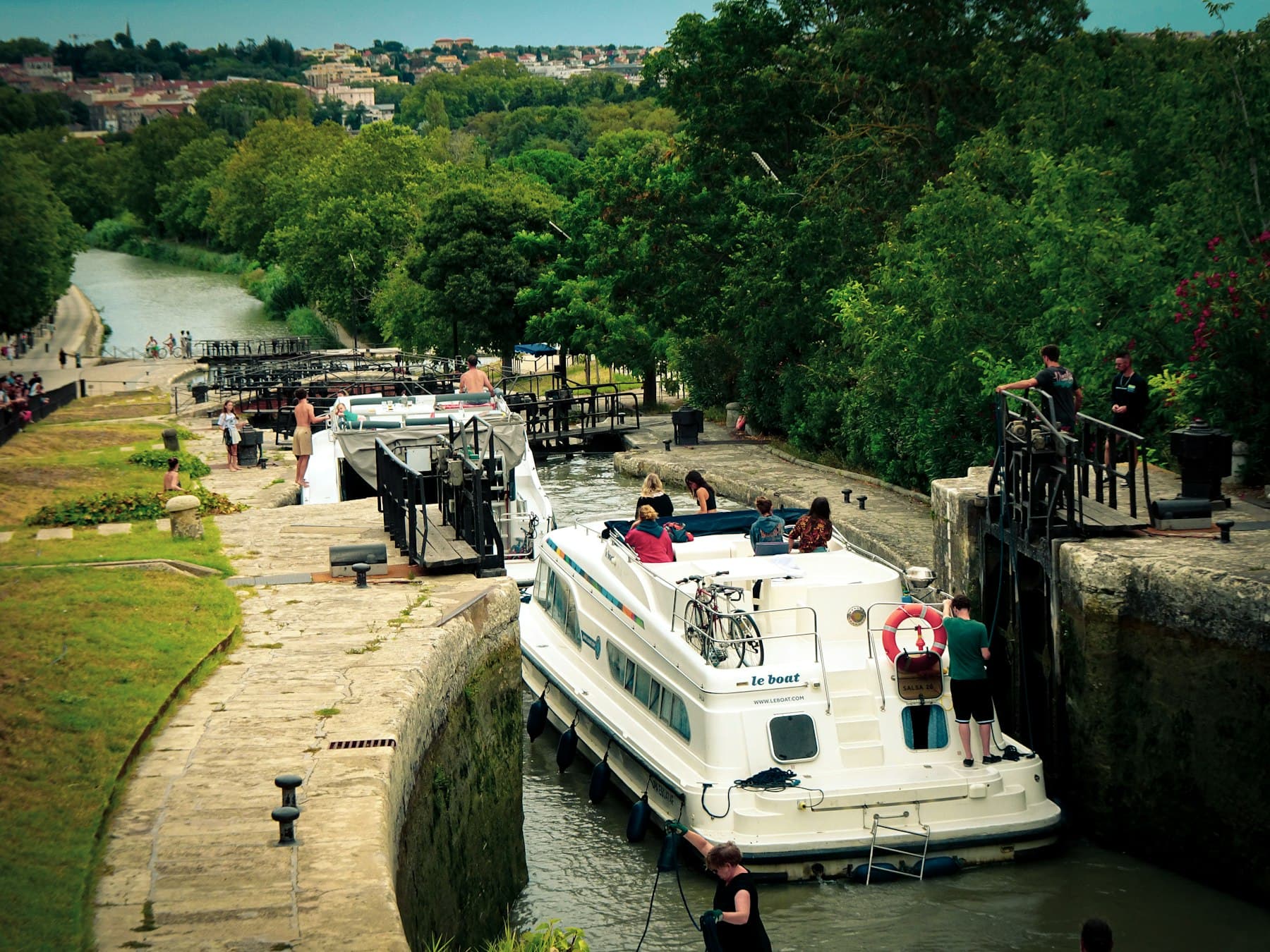
Passing a lock means entering the chamber slowly, mooring doubled around the bollards, letting the keeper or the automated system raise or lower the water, then leaving on the signal. The manoeuvre is impressive the first time, but it is well within reach of any prepared crew: two lines, fenders on both sides, a boathook, and jobs shared out before you enter.
How a lock works
A lock is a water lift: a chamber closed by two sets of gates, sluices that fill it from upstream or drain it downstream, and the boat rising or falling with the water level. Depending on the waterway, operation is handled by a lock keeper, by an automated system triggered with a remote control, or by a pole to twist hanging over the channel a few hundred metres before the lock.
Two practical realities to absorb from the start: locks keep operating hours (including lunch breaks on some canals), and larger commercial waterways are worked on VHF — you announce your arrival and follow instructions. The vocabulary — chamber, bollard, upstream, downstream — is covered in the glossary.
Preparing the boat before the chamber
Preparation happens on the waiting pontoon, never inside the lock:
- Plenty of fenders, set low, on both sides: the walls are rough and you do not always choose your side.
- Two lines ready, one forward and one aft, coiled to run without a knot or a surprise.
- Boathook to hand, to reach a high bollard or fend off the wall.
- Gloves for the crew: a running line burns bare hands.
- Bimini and antennas checked: air draft can come down to centimetres under the bridges before the lock.
Share out the roles before entering: one helm who stays at the wheel with the engine in gear, one crew member per line.
The passage, step by step
Enter slowly, aiming for the spot indicated by the keeper or, failing that, the middle of the chamber. Run each line doubled around the bollard — both ends stay on board — and never tie a knot: the whole art of locking through is being able to ease or take in continuously.
Going up, the sluices create genuine turbulence, strongest at the front of the chamber: position yourself further back, engine in gear to counter the swirl, and take in the slack as the boat rises. In large locks fitted with floating bollards it is simpler still: you never touch the line again, the bollard rises with you.
Going down, the manoeuvre is gentler but the trap is nastier: a jammed or too-short line holds the boat while the water drops — the classic hanging-boat accident. One crew member stays at each line, ready to ease, with a knife accessible as a last resort. You never take your eyes off your lines in a lock chamber.
Speed, passing and priorities on the canal
Between locks, the canal sets its own pace: 6 to 8 km/h in most places, less when passing moored boats. The golden rule is no breaking wash — the wake that erodes the banks and shakes moored boats; if your wave is breaking, you are going too fast. You pass port to port as at sea, and you give way to commercial barges, whose manoeuvrability is limited and whose suction effect can pull your boat toward the bank if you shave past them. At movable bridges and in narrow sections, patience: whoever is committed first goes through.
Draft, air draft and waterway licences
Before any inland cruise, three numbers govern everything: your draft, your air draft (mast included — on a sailing yacht, the mast comes down) and the gauge of the waterway you are aiming for. Real depths often run below the theoretical figures; check the notices to skippers before departure. An up-to-date waterway guide and our page on France's canals help with route planning.
As for paperwork, most networks charge for access and the rules depend on your flag and the country you cruise in: in France a VNF vignette is required, priced on boat area and duration — from a few-day pass to a full year, from tens to several hundred euros for a typical pleasure boat; the UK, Belgium and the Netherlands run their own licence and toll systems. Fee scales change regularly, so check the current tariff before setting off, along with the helmsman qualification your waterway requires — in France an inland licence applies above 6 hp, except on so-called licence-free hire boats.
Where to start
- Treat yourself to a first experience on a hire penichette: instruction is included, and so is the insurance — the river boats family exists for exactly this.
- Pick a small automated lock at a quiet hour for your debut, not a large-gauge lock on an August Saturday.
- Brief the crew with the three rules that save the day: doubled lines, never a knot, ease on the way down.
- Gloves for everyone, and one adult per line.
After three locks, the manoeuvre becomes a crew pleasure — and the canal one of the most beautiful slow ways to travel.
Frequently asked questions
Do you need a licence to pass through a lock?
The lock itself requires no qualification, but helmsman rules apply to the waterway: in France an inland licence is required above 6 hp, while several countries run comparable schemes with different thresholds. The notable exception is licence-free hire boats, available after instruction from the hire base. Rules vary by country and flag — check before you set off.
How do you moor in a lock going up?
Run your bow and stern lines doubled around the bollards, both ends on board, and never tie a knot. Position yourself toward the back of the chamber, where the filling turbulence is weaker, with the engine in gear to hold the boat. One crew member per line takes in the slack as the boat rises, and the helm never leaves the wheel.
How much does a canal cruising licence cost?
In France, the VNF vignette is priced on boat area (length times beam) and the formula chosen: a few-day pass, a leisure package or a full year — from tens of euros for a short stay to several hundred for a year on a typical pleasure boat. Other countries price differently, such as the annual boat licence on UK waterways. Scales are revised regularly: check the current tariff for your waterway before departure.
The surest way to know a boat is to sail her.
Before you buy — or simply to get away this season. Tell us your dates and your cruising area, and we source the right boat through our network of owners and vetted fleets.