Planing, semi-displacement, displacement hulls explained
Displacement, semi-displacement or planing hulls: the simple physics, real-world fuel burn and how to choose the right hull for your programme.
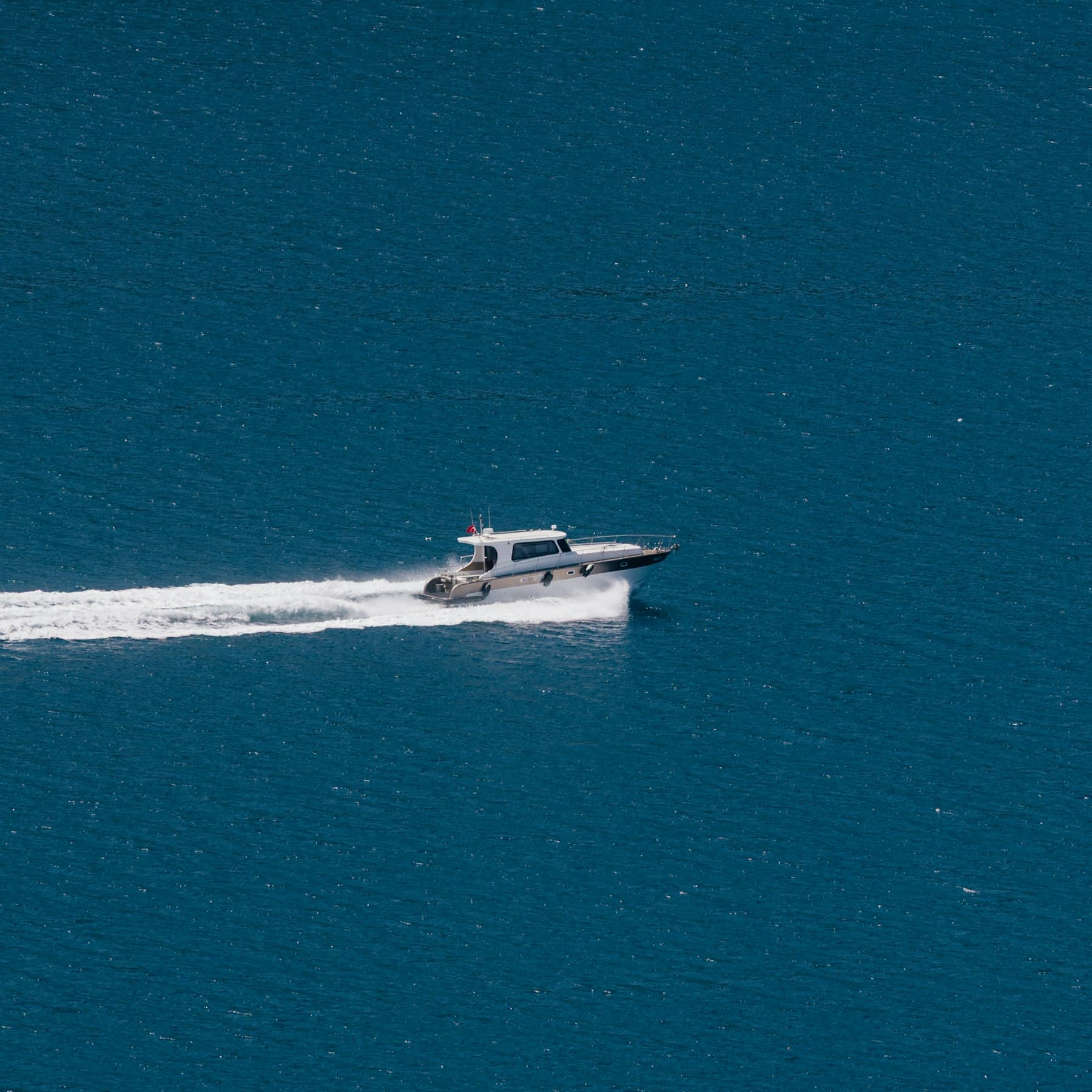
A displacement hull pushes through the water and is capped by its hull speed, roughly 2.4 times the square root of the waterline length in metres, expressed in knots. A planing hull uses hydrodynamic lift to climb over that limit and skim across the surface, at the cost of far higher fuel burn. Semi-displacement sits between the two: it stretches the limit without ever fully flying.
The physics in two minutes
Every moving boat pushes water aside and creates a wave system: one at the bow, one at the stern. The faster it goes, the longer those waves become, until their wavelength equals the waterline length. The boat is then trapped in its own trough: going faster would mean climbing its own bow wave, which demands absurd power. That is the famous hull speed. For a 10-metre waterline, expect around 7.5 knots. There are two escapes: stretch the waterline, which is the logic of multihulls and big yachts, or climb out of the water on lift-generating surfaces. The planing hull takes the second route: beyond a critical speed, water pressure under a relatively flat bottom lifts the hull, and resistance drops sharply.
Displacement: eating up miles on a budget
Cruising sailboats, trawlers and canal boats share the same logic: deep, rounded shapes that travel through the water rather than over it. The advantages are substantial: tiny fuel burn (a 12-metre trawler burns 6 to 10 litres per hour at 7 knots), range measured in hundreds or thousands of miles, a gentle motion in a seaway, and generous load-carrying ability. The limits are just as clear: you will never exceed 8 or 9 knots whatever the engine, and rolling at anchor or downwind can wear the crew out, which is why stabilisers are so popular on long-range motor yachts. This is the hull for programmes where the passage matters as much as the destination.
Planing: speed is paid by the litre
Fast cruisers, centre-consoles, RIBs and sportboats rely on V-shaped hulls that get onto the plane between 12 and 16 knots and cruise at 20-30 knots. The gain is obvious: three times the hourly range, half-day trips that would otherwise take a full day, and genuine driving pleasure. So is the cost: an 8-metre open boat with 300 hp easily burns 50 to 70 litres per hour at a fast cruise. Comfort depends heavily on sea state: on the plane, the hull slams into chop, and a deep-V softens the impacts at the price of some stability at rest. On well-designed sport cruisers, the balance between forward V and aft lift makes all the difference.
Semi-displacement: the honest compromise
In between, semi-displacement combines a fine entry that slices the sea with a flatter aft section that generates lift. The result is a wide operating range, from 7 to 15-18 knots depending on the model. This is the hull of fast trawlers and many Nordic pilothouse boats: you cruise economically at 8 knots and push to 14 to beat the squall home. The catch: pushing is expensive, because resistance climbs steeply in the intermediate zone, and the boat does neither job as well as a specialist. For many coastal programmes it is still the smartest trade-off.
What the hull changes day to day
Beyond headline speeds, the hull shapes your actual experience at sea:
- Seakeeping: displacement hulls handle heavy weather better; planing hulls force you to throttle back as soon as the sea builds.
- Rolling at anchor: round bilges roll, hard-chine hulls damp the motion.
- Fuel burn: from 1 to 1.5 litres per mile in displacement mode to 2.5-4 litres per mile planing, as orders of magnitude.
- Draught: often shallower on planing hulls, an asset in thin anchorages.
- Resale: a boat that matches how people actually use boats in your area sells faster.
Learning to spot these clues in a listing is a real edge: our guide on reading a spec sheet covers the ratios that reveal a hull's character.
Which hull for your programme
Start from your use, never from the brochure. Short trips from a home port, swimming, watersports: planing wins. Coastal cruising with 30 to 60-mile legs: semi-displacement or a sober planing hull, depending on your fuel-budget tolerance; our trawler or fast cruiser comparison puts numbers on that choice. Long-range cruising, autonomy, comfort in a seaway: displacement, without hesitation. Before you sign, run each candidate through the cost of ownership calculator: for the same programme, the hull type can triple your annual fuel bill. Finally, try both worlds in real conditions; one hour at sea is worth every catalogue ever printed.
Frequently asked questions
What is the difference between a planing hull and a displacement hull?
A displacement hull travels through the water and is capped by its hull speed, around 7 to 9 knots for a typical cruiser. A planing hull rises onto the water above a critical speed and can cruise at 20-30 knots. The first favours range and comfort, the second favours speed at the cost of much higher fuel burn.
What is the maximum speed of a displacement hull?
It is set by hull speed: roughly 2.4 times the square root of the waterline length in metres, in knots (or 1.34 times the square root of the length in feet). A boat with a 10-metre waterline tops out around 7.5 knots, a 16-metre around 9.7 knots. Adding power beyond that just digs a deeper wave and burns fuel.
Do semi-displacement hulls burn a lot of fuel?
It depends entirely on the throttle. At 7-8 knots, a semi-displacement hull burns almost as little as a pure displacement boat. Push towards 12-15 knots and consumption can triple or quadruple, because the boat operates in the zone of maximum resistance. It is an excellent compromise if speed stays an option rather than a habit.
Reading is the easy part. Then you have to decide.
A boat purchase turns on what you cannot see: the real history, the state of the hull below the waterline, how much room there is to negotiate. We represent you — independent of any seller, paid by you alone.