The galley: equipping, provisioning, cooking at sea
Equipping a galley (gas or induction, fridge), provisioning for a week and cooking while heeled: practical methods, realistic budgets, proven habits.
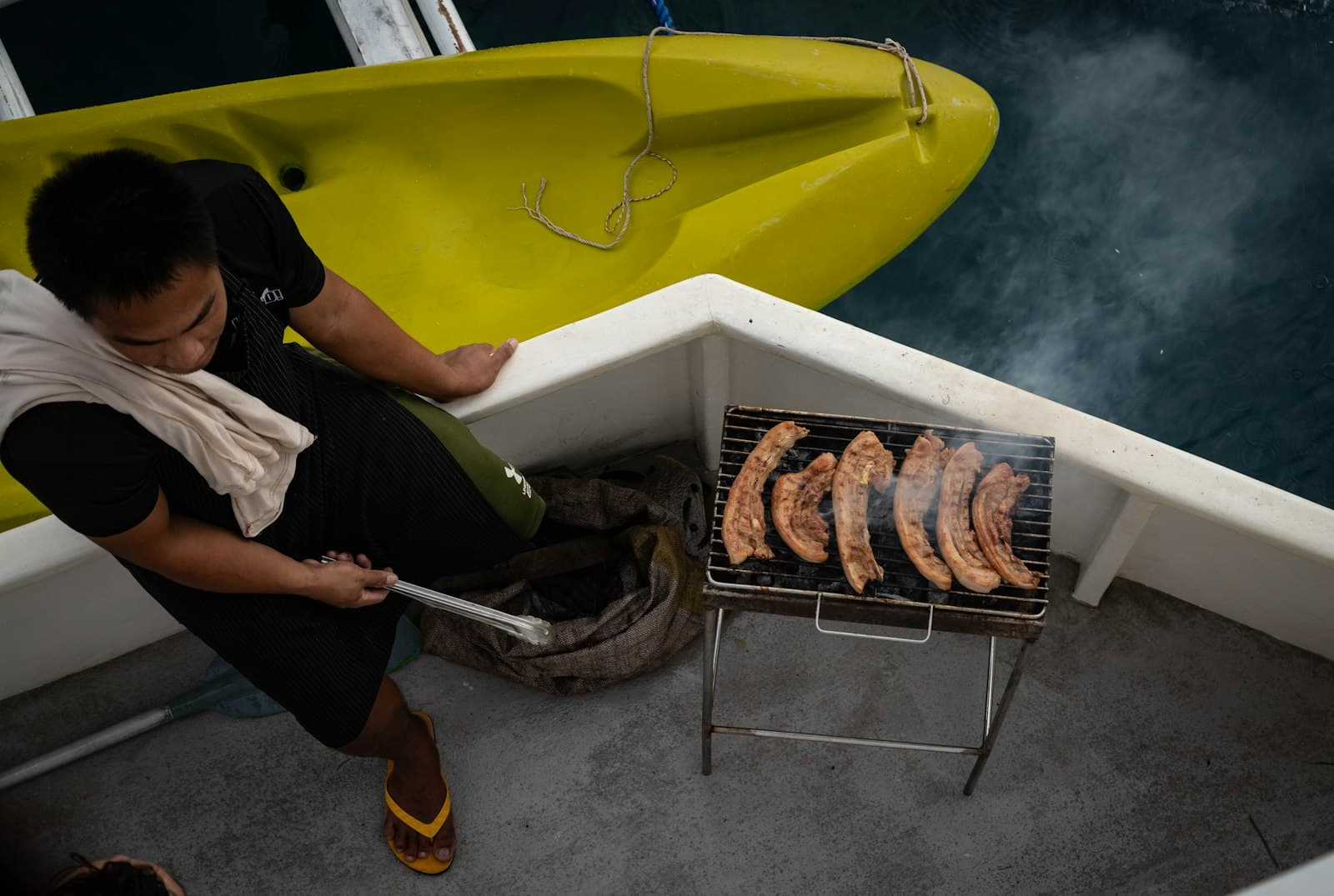
A good galley rests on three decisions: the heat source (gas equips the vast majority of boats, induction is gaining ground where the electrical system allows), refrigeration sized to the energy you actually produce, and ergonomics that work at sea. Budget 60 to 100 euros per person per week of provisioning to eat well aboard.
Gas, induction or alcohol: choosing your heat source
Gas (butane or propane) remains the standard: powerful, independent of your batteries, with bottles available almost everywhere — though fittings change from country to country, which complicates long voyages. The installation must be beyond reproach: a recent regulator, dated hoses within their validity period, an accessible shut-off valve and a gas detector at the lowest point of the boat; follow your flag state's regulations for the details. Induction makes sense on recent boats with lithium banks and serious charging capacity: no gas aboard, but 1,500 to 2,000 W to supply at every meal. Alcohol stoves survive on small boats: simple and safe, but slow. Whatever you choose, carry a way to boil water if the main system fails — a basic camping stove stowed in a locker has saved many a passage.
Refrigeration: the fridge, your batteries and the trade-offs
The fridge is often the biggest single consumer aboard: 30 to 60 Ah per day at 12 V for a 40-100 litre box, depending on insulation, water temperature and lid discipline. Three levers lighten the bill: over-insulate the box, set 4-5 °C rather than 2, and batch your openings. A freezer doubles the energy cost — a luxury best reserved for boats with a strong energy budget. A proven trick: chill drinks in a soft cooler with ice bought at departure, and keep the fridge for what genuinely deserves it. Measure real consumption over 24 hours before planning any additional equipment.
Ergonomics that work at sea
A marina galley and a seagoing galley are two different things. Under way, everything must hold: fiddles (raised edges) on worktops, grab bars, locking drawers, compartmentalised lockers. A gimballed stove, which stays level as the boat heels, is essential for offshore sailing, completed by a galley strap so the cook can work hands-free. A deep sink doubles as a safe parking spot for a hot pan. Look at the sink-stove-fridge triangle too: three steps too many are paid at every single meal. Our glossary covers the vocabulary if needed — gimbal, fiddle and locker quickly become everyday words. If you are still choosing a boat, cook an imaginary meal in the galley during the viewing: the flaws show up immediately.
A typical week's provisioning
For two people on a week of coastal cruising:
- Staples: pasta, rice, couscous, flour, pulses (2 to 3 kg in total).
- Tins and jars: tomatoes, tuna, sardines, vegetables, two emergency ready meals (10 to 15 units).
- Short-life fresh food, for the first three days: meat, fish, salads.
- Long-keeping fresh food: eggs, cabbage, carrots, potatoes, onions, citrus, apples.
- UHT dairy, coffee, tea, biscuits, chocolate — morale counts as much as calories.
- A night-watch locker: nuts, dried fruit, instant soups, cereal bars.
- Water: 2 to 3 litres per person per day including cooking, bottled or from treated tanks.
Stow heavy and low, note which locker holds what and keep a list: hunting a tin of tomatoes through six lockers is a sport that gets old fast.
Cooking while heeled without getting burned
The golden rule: prepare in port whatever can be prepared. Chopping vegetables, pre-cooking a dish and filling a thermos of coffee before slipping lines transforms the passage. Under way: tall pans half-full, a pressure cooker (locked lid, nothing jumps out), one-pot dishes, and long sleeves and trousers for the cook — boiling water is the number-one burn risk aboard. In rough weather nobody ever failed by serving couscous salad and tins: a fed crew is a crew that lasts. Remember that seasickness strikes the cook first — if you are prone to it, prepare everything before departure and keep the first passages short. Full-time liveaboards (see living aboard year-round) all end up radically simplifying their sea cooking anyway.
Where to start
- Audit what you have: age of gas hoses, state of the regulator, actual fridge consumption measured over 24 hours.
- Fit the minimum safety kit: gas detector, galley strap, pressure cooker, thermos.
- Test a one-week provisioning plan on a long weekend and note what ran out and what came home untouched.
- Standardise your sea menus: five robust recipes beat a cookbook.
- Size refrigeration after the energy audit, never before.
Frequently asked questions
Gas or induction on a boat?
Gas remains the default choice: powerful, self-sufficient, repairable everywhere. Induction only becomes relevant if the boat has a substantial lithium bank, a large inverter and genuine recharging capacity (solar, upgraded alternator): every meal demands 1,500-2,000 W. On a well-equipped recent boat it removes gas and its constraints; on a classic boat, gas wins.
How much power does a boat fridge use?
A 40-100 litre compressor fridge typically draws 30 to 60 Ah per day at 12 V. The range depends on box insulation, water temperature (a Mediterranean August pushes the bill up) and how often the lid opens. A freezer roughly doubles that consumption. Measure over 24 hours with a battery monitor to know your real figure.
How do you keep food fresh without a fridge aboard?
Choose foods that keep at ambient temperature: eggs, cabbage, carrots, potatoes, onions, citrus, hard cheeses, dry-cured meats. Stow them low against the hull, below the waterline, in ventilated nets. Tins, jars and UHT dairy provide the base. In practice you eat the fragile fresh food in the first three days, then switch to long-keeping produce.
The surest way to know a boat is to sail her.
Before you buy — or simply to get away this season. Tell us your dates and your cruising area, and we source the right boat through our network of owners and vetted fleets.