Power on board: batteries, solar, lithium, generator
Energy budget, battery bank, solar panels, lithium, generator: how to size your boat's electrical system so the power never dies at anchor.
Onboard energy comes down to a simple equation: whatever you consume each day must be put back each day by your charging sources. A modern cruising boat draws between 60 and 200 amp-hours (Ah) per 24 hours at anchor; your job is to size the battery bank that stores that energy and the sources — solar, alternator, generator — that replace it. Everything else is installation detail.
The energy budget: the mandatory starting point
Before buying a single panel, list every consumer with its power draw and daily runtime: fridge (40-60 Ah/day on its own, often half the total), autopilot, navigation electronics, lighting, pumps, phone chargers, windlass. Add it up. That Ah/day figure drives every sizing decision — and it is the first thing any professional will ask you for. Model spec sheets rarely give this detail: buyers have to build it around their own programme.
The battery bank: flooded, AGM or lithium
Flooded lead and AGM batteries remain the most common: reliable, affordable, but they hate dropping below 50% charge and age quickly when mistreated. In practice a 400 Ah AGM bank offers only 200 usable Ah. Lithium (LiFePO4) changes the game: 80-90% usable capacity, fast charging, half the weight, triple the cycle life — against roughly double the purchase price and an installation that must be engineered (BMS, compatible chargers, sometimes insurer sign-off). On a boat that lives at anchor, lithium pays for itself in real comfort; on a marina boat that sails six weekends a year, AGM is plenty.
Solar: the anchorage's primary source
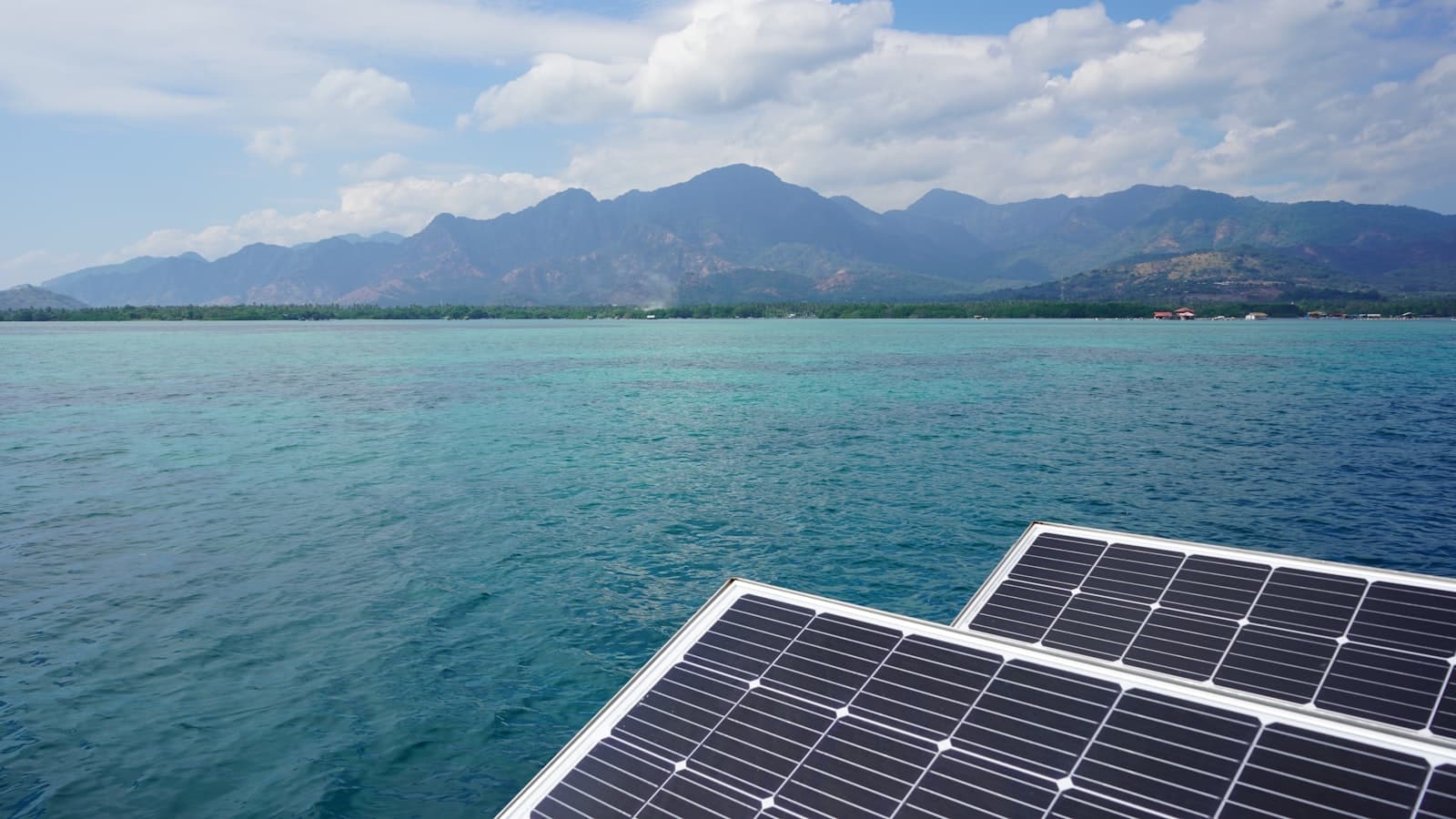
Solar has become the backbone of autonomy: silent, maintenance-free, producing while you swim. In the Mediterranean summer, count on 4-5 hours of full-power equivalent: a 200 W panel returns 800-1,000 Wh, about 65-80 Ah at 12 V. A cruising monohull targets 200-400 W (arch, bimini); a catamaran easily carries 800 W or more on its coachroof — one reason for their popularity in long-range cruising, as covered in our boat families. Fit an MPPT controller, noticeably more efficient than older PWM units.
Alternator, hydrogenerator, wind
The engine charges through its alternator: useful on passage, frustrating at anchor (an hour of engine for 50-80 Ah, with noise and wear for nothing). A high-output alternator, or a second one dedicated to the house bank, turns every motoring hour into real charging. Hydrogenerators shine on ocean passages (a steady 5-10 A under sail at 6 knots); wind generators have lost ground to solar — noisy, and productive only above 15 knots of breeze.
The generator and 230 V question
Air conditioning, induction cooking, high-output watermakers: once 230 V becomes permanent, a generator imposes itself — typically above 15 metres. It is a second engine to maintain, soundproofed but never silent. The modern alternative: a large lithium bank plus an inverter/charger (around 3 kVA) absorbing the peaks, with the generator running only for bulk recharges. Many recent yachts, including motor yachts in our files, adopt this hybrid architecture.
Monitoring: the gauge that tells the truth
A voltmeter lies: battery voltage moves with charge, load and temperature, and a bank can read 12.4 V while quietly dying. A shunt-based battery monitor — which counts every amp in and out — displays a true state of charge in percent, plus consumption in real time. It costs a few hundred euros, takes an afternoon to fit, and changes behaviour aboard more than any new panel: once the crew sees the fridge pulling 5 A, doors stop staying open. If you upgrade only one thing this season, make it this.
Where to start
Build an honest energy budget, then size in this order: battery bank = 3-4 times daily consumption (lead) or 1.5-2 times (lithium); solar = able to replace 70-100% of summer consumption; the rest (upgraded alternator, generator) fills the gaps. And before any heavy investment, hunt down savings: a well-insulated fridge and LED lighting recover more amp-hours than many panels ever will.
Frequently asked questions
How much battery capacity does a cruising sailboat need?
Size the house bank at 3-4 times your daily consumption for lead/AGM (e.g. 400 Ah for 100-120 Ah/day), or 1.5-2 times for lithium. Add a dedicated engine start battery, always separated from the house bank by an isolator or combiner.
Is lithium worth it on a boat?
Yes if you live at anchor or cruise extensively: double the usable capacity, fast charging, triple the lifespan. It is not a priority for a lightly-used marina boat, where recent AGMs do the job for far less. Check charger/alternator compatibility and inform your insurer.
How much solar power for autonomy at anchor?
Aim for summer production covering 70-100% of consumption: in the Mediterranean, roughly 200-400 W on a 12-metre monohull, 600-1,000 W on a catamaran. An MPPT controller and less shading are often worth an extra panel.
Reading is the easy part. Then you have to decide.
A boat purchase turns on what you cannot see: the real history, the state of the hull below the waterline, how much room there is to negotiate. We represent you — independent of any seller, paid by you alone.