Sail or power: understanding the two worlds
Sail or power? Philosophy, learning curve, real running costs and typical profiles: an honest comparison to pick the world that fits your programme.
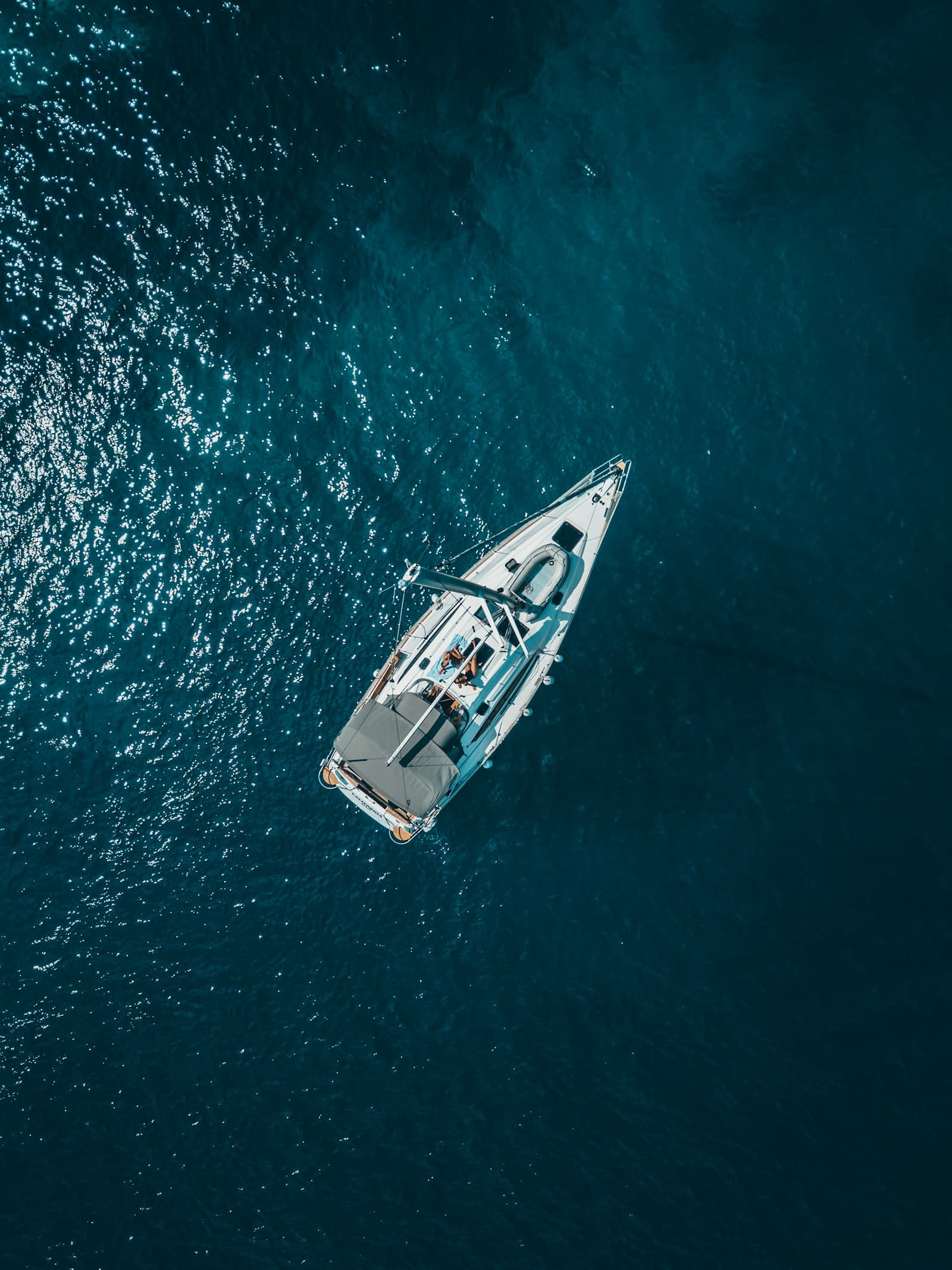
Choosing between sail and power is choosing between two relationships with time. Sail favours the journey: slow, silent, cheap to run, demanding to learn. Power favours the destination: fast, easy to pick up, instantly comfortable, but thirsty. Neither world is objectively better: the right answer flows from your cruising programme, your running budget and how much time you are willing to invest in learning.
Two philosophies of the sea
Under sail, sailing is the whole point. You work with the wind, trim, anticipate the weather, and an afternoon of 15 knots of breeze becomes free entertainment that can last for hours. A sailboat imposes its slowness — 5 to 8 knots on average — and that is precisely what its followers seek: the passage matters more than the arrival, and the silence under sail has to be lived to be understood.
Under power, the boat is a superb destination tool. The cove reached in forty minutes, the restaurant on the next island, the weekend 40 miles away: speed — 20 to 30 knots for a sports cruiser — compresses distance and frees up time once you are there. This is the world of limited time, busy families and precise plans.
Learning: two very different curves
Sailing takes years to master properly: trim, points of sail, fine-grained weather, harbour manoeuvres with a boat that drifts. It is a long road, but the progression is part of the pleasure, and sailing-school courses — roughly 500 to 700 € a week in Europe — speed the curve up considerably.
Power can be picked up in days: where a licence is required, it is usually earned over an intensive weekend, and the driving itself is intuitive. Beware the false sense of ease, though: docking in a crosswind, weather judgement, anchoring and general seamanship are common to both worlds — and that is where most incidents happen, not offshore. A sensible plan for a power-first beginner is therefore simple: pass the qualification, then book a couple of extra hours with an instructor on your own boat, in your own marina, on a breezy day.
Costs: similar to buy, very different to run
At equal length, purchase prices overlap broadly. It is the structure of running costs that diverges:
- Fuel: a 40-foot planing cruiser burns 100 to 150 litres per hour at 25 knots; a sailboat of the same size, 3 to 5 litres under engine — and nothing under sail.
- Sails and rigging: a cruising sail wardrobe costs 8,000 to 15,000 € every 8 to 12 years, and standing rigging is replaced every 10 to 15 years (3,000 to 8,000 €).
- Engines: motor boats often carry two, which means two annual services, two drives, two sets of anodes.
- Berth, insurance, storage: broadly identical at equal size.
Overall, the 8-to-12%-of-value-per-year rule applies to both worlds, but heavy use quickly widens the gap in sail's favour. The guide What a yacht really costs breaks down every line item, and the cost-of-ownership calculator lets you price your own scenario.
Who each world is for
- You have time, enjoy learning and dream of going far: sail, and the vast choice of cruising sailboats.
- Your weekends are short and the family wants to swim quickly and be home early: power, from day boat to sports cruiser.
- You want long distances on a controlled fuel budget: sail — or an economical trawler at 8 knots.
- You love fishing, waterskiing and towed sports: power, no hesitation.
The bridges between the two worlds
The border is porous. Trawlers turn slow, frugal motoring into a philosophy close to sailing, long range included. Power catamarans transpose the volume and stability of their sailing cousins. And many boaters switch sides over a lifetime: the classic trajectory runs from sail to the motor yacht when knees or free time no longer keep up. Nothing stops you owning one and chartering the other, either.
Where to start
Try both worlds before deciding: it is the only reliable test. A five-day sailing course costs 500 to 700 €; a skippered day on a motor boat, 400 to 800 € shared between participants. Follow with a week's charter in whichever world attracts you, in real conditions, with your usual crew — they are the ones who will live with the choice. If the debate is still open after that, your programme is probably not precise enough yet: rework it around cruising area and the time genuinely available each year, and the choice will make itself.
Frequently asked questions
Is a sailboat cheaper to run than a motor boat?
In running costs, usually yes: the fuel bill of a fast motor boat quickly exceeds the cost of sails and rigging on a sailboat of the same size. But a rarely used sailboat, with sails and rigging to replace periodically, can cost as much as a gently used cruiser. The 8-12%-of-value-per-year rule applies to both.
Is it hard to learn to sail?
The basics come in a one-week course; genuine ease takes two or three seasons of regular practice. Age is not the issue: cruising schools train beginners in their 40s, 50s and 60s every year. The real difficulty is consistency — sailing regularly and building up conditions progressively.
Can you cover long distances in a motor boat?
Yes, provided you pick the right hull. A displacement trawler covers hundreds of miles at 7-9 knots while burning 5 to 10 litres an hour. It is planing cruisers that limit range: at 25 knots, endurance often comes down to just 150-250 miles.
The surest way to know a boat is to sail her.
Before you buy — or simply to get away this season. Tell us your dates and your cruising area, and we source the right boat through our network of owners and vetted fleets.